
5 writing systems you have probably never heard of.
The Deseret alphabet
Deseret is a phonetic alphabet for English. Brigham Young commissioned it around 1854 because he thought English spelling was broken. A committee in Salt Lake City designed 38 new letters for the job. One sound got one letter, with no silent letters allowed.
The shapes were brand new. They look a bit like Pitman shorthand and a bit like Cyrillic.
The territory spent real money on the project. Schoolbooks went to press and two editions of the Book of Mormon came out. A few gravestones even got the new letters carved into them.
Then it died off quickly. Re-tooling every press turned out to be expensive. Ordinary people had no interest in learning a second alphabet. By the 1870s almost nobody was using it anymore.
Ogham
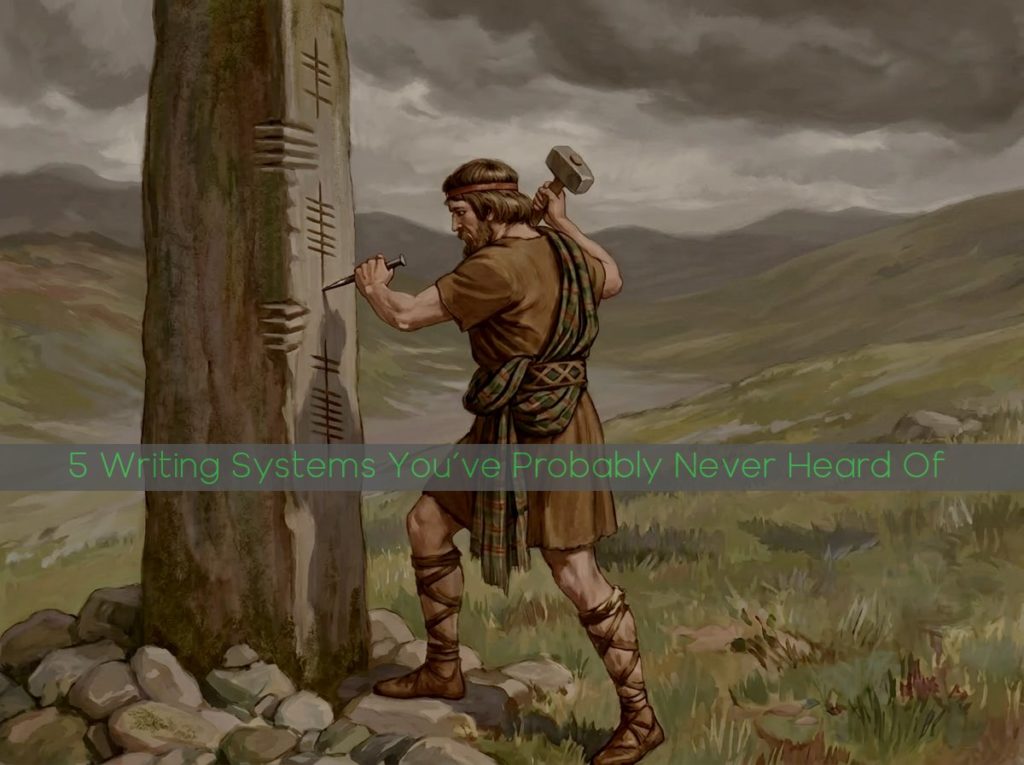
Ogham is an alphabet used to write early Irish. It was carved into standing stones across Ireland and a few sites in western Britain. Most of it dates from the fourth to sixth centuries.
The text runs up the corner of the stone. Notches and short strokes branch off that edge. You read from the bottom upward.
It started with twenty letters and gained five more later on. Medieval Irish writers gave each letter a tree name. Beith meant birch and dair meant oak. Whether the trees came first or the letters did is still argued today.
Roughly four hundred inscriptions are known to survive. The contents are mostly dull stuff. Usually a name and whose son the man was. Sometimes a tribal affiliation gets thrown in.
Rongorongo
Rongorongo is a script from Easter Island. A French missionary noticed it in 1864. Nearly every house had wooden tablets covered in tiny carved figures. The shapes included birds, fish, standing humanoids, and small geometric marks the size of a fingernail.
Nobody alive could read the things by then. Peruvian slavers had hauled off most of the literate men a few years before. Smallpox took the rest.
Roughly two dozen genuine pieces survive today. They sit in museums in Rome, Santiago, Saint Petersburg, Honolulu, and a handful of other cities.
The reading direction is the odd part. You read one line from left to right. Then you flip the tablet upside down for the next line. Then you flip it back for the line after that. The technical name is reverse boustrophedon.
A century and a half of decipherment attempts have produced almost nothing solid.
Glagolitic
Glagolitic is the oldest Slavic alphabet invented by Byzantine missionary Cyril and his brother Methodius around 860. The point was to give the Slavs church services in their own language.
The letters are loopy and full of small circles and triangles. They do not look much like anything else around.
Cyrillic came later. Cyril’s students built it out of Greek capitals after he was dead. They kept a few Glagolitic letters for the sounds Greek did not cover. Then they named the whole thing after their teacher.
Glagolitic itself hung on in odd corners of Europe. The longest holdout was Croatia. Catholic priests on the Dalmatian coast were still using it in the Mass during the 1800s. The last Glagolitic missal was printed in Rome in 1893.
Cherokee
The Cherokee script is a syllabary rather than an alphabet. Each character stands for a whole syllable. There are 85 of them in use today, with an 86th that got dropped along the way.
Sequoyah invented it on his own. He was illiterate but he understood perfectly well what writing was. The Cherokee had been dealing with literate Europeans for generations by then. He simply wanted the same tool for his own language and decided to build it himself.
He started off trying to make one character for every word. That approach got out of hand quickly. He scrapped most of his early work and switched to syllables instead. The whole project took him about twelve years to finish.
He pinched letter shapes from books he could not read. Some came from Latin and some from Greek, with a few that look closer to Cyrillic. He pasted them onto Cherokee sounds with no regard for their original values. The character shaped like R sounds like /e/. The one shaped like D sounds like /a/. The one shaped like 4 sounds like /se/.
The uptake was remarkably fast. By 1825 most of the Cherokee Nation could read and write in their own tongue.
The Cherokee Phoenix newspaper started up in 1828 with parallel columns in English and Cherokee. The editor Elias Boudinot tidied up the character shapes for the printing press around the same time. Samuel Worcester made a few more tweaks in 1834. He flipped the do character upside down so it would stop being mistaken for the go character.
The script is still alive today. Tahlequah and the town of Cherokee in North Carolina both have street signs in syllabary. Children’s books come out in it for the immersion schools. Apple and Google both ship Cherokee keyboards.